The Lasting Taste of Experience: Why People Remember More Than What They Consume
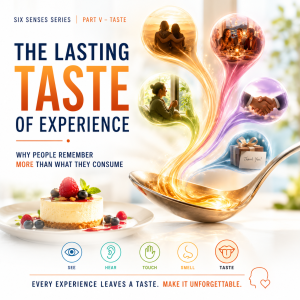
Six Senses Series | Part V — Taste
Some Experiences Leave a Taste That Lasts Long After They’re Over
Think about the phrase:
“That left a bad taste in my mouth.”
Most of the time… No one is talking about food.
They’re describing an experience.
A difficult conversation.
A disappointing customer interaction.
A broken promise.
Now consider the opposite.
A handwritten thank-you note.
An employee who solved your problem without being asked.
A leader who gave you credit instead of taking it.
Those moments leave a different kind of taste.
Long after the details fade, the feeling remains.
That is the remarkable power of taste.
It is more than a physical sensation.
It becomes a metaphor for how we remember experiences.
Taste Is Never Experienced Alone
Take a bite of a strawberry.
Is the sweetness determined only by your tongue?
Not even close.
Scientists have discovered that what we call flavor is actually a multisensory experience created by taste, smell, vision, texture, temperature, and even sound.
Your brain combines all of these sensory signals into what feels like a single experience.
Without smell, much of what we describe as flavor disappears.
Research from the National Institute on Deafness and Other Communication Disorders (NIDCD) explains that flavor depends on the integration of taste and smell, with additional contributions from texture, temperature, and chemesthetic sensations such as cooling or heat.
Research Source: Smell Disorders – National Institute on Deafness and Other Communication Disorders (NIDCD)
https://www.nidcd.nih.gov/health/smell-disorders
That insight reaches far beyond food.
Customers never evaluate one interaction in isolation.
They experience the whole.
Expectation Changes What We Taste
Imagine pouring the same wine into two different bottles.
One carries a prestigious label.
The other is plain.
Many people will genuinely believe one tastes better.
Why?
Because expectations shape perception.
Neuroscientists have shown that beliefs about a product can influence activity in brain regions associated with experienced pleasantness, meaning expectations don’t merely change opinions, they can change the experience itself.
Research Source: Plassmann, H., O’Doherty, J., Shiv, B., & Rangel, A. Marketing Actions Can Modulate Neural Representations of Experienced Pleasantness.
https://www.pnas.org/doi/10.1073/pnas.0706929105
People rarely experience reality without expectation.
Expectation becomes part of the experience.
The Brain Remembers the Ending
Psychologists Daniel Kahneman and Barbara Fredrickson demonstrated that people do not evaluate experiences by averaging every moment.
Instead, memory is disproportionately shaped by the emotional peak and the ending.
This is known as the Peak-End Rule.
A customer may overlook small frustrations if an experience ends exceptionally well.
Likewise, a great experience can be overshadowed by a poor conclusion.
Research Source: Kahneman, D., Fredrickson, B., Schreiber, C., & Redelmeier, D.
When More Pain Is Preferred to Less: Adding a Better End.
https://pubmed.ncbi.nlm.nih.gov/10492763/
Every interaction leaves a final impression.
Every final impression leaves a lasting taste.
The Best Brands Create Emotional Flavor
Think about your favorite restaurant.
You probably remember more than the meal.
You remember how you were greeted.
The atmosphere.
The conversation.
The presentation.
The laughter.
The people around the table.
The meal became inseparable from the experience.
The same is true in business.
People don’t buy products.
They consume experiences.
Every interaction adds another ingredient.
Eventually…
Your brand develops a flavor of its own.
The Selling Senses Connection
In Selling Senses, taste represents the emotional aftertaste of every interaction.
Did your customer leave feeling understood?
Did your presentation leave people inspired?
Did your leadership create confidence?
Did your service leave someone wanting to return?
Those questions matter because people rarely remember every detail.
They remember how the experience settled.
Long after the transaction ends…
Something remains.
That lingering impression becomes your reputation.
What the Research Really Shows
The evidence reveals an important truth.
- Flavor is created by multiple senses working together—not taste alone.
- Expectations shape how people experience products and services.
- The emotional peak and ending disproportionately influence how experiences are remembered.
- Great brands don’t simply satisfy customers.
They leave a lasting emotional aftertaste.
Together, these findings reveal something every leader, marketer, and salesperson should remember.
People don’t just consume products.
They consume experiences.
And every experience leaves a taste that shapes whether they return.
Research Sources
1. National Institute on Deafness and Other Communication Disorders (NIDCD)
Smell Disorders
https://www.nidcd.nih.gov/health/smell-disorders
2. Plassmann, H., O’Doherty, J., Shiv, B., & Rangel, A.
Marketing Actions Can Modulate Neural Representations of Experienced Pleasantness.
Proceedings of the National Academy of Sciences
https://www.pnas.org/doi/10.1073/pnas.0706929105
3. Kahneman, D., Fredrickson, B., Schreiber, C., & Redelmeier, D.
When More Pain Is Preferred to Less: Adding a Better End.
https://pubmed.ncbi.nlm.nih.gov/10492763/
Continue the Journey
This article is Part V of the Six Senses Series.
If you missed Part IV, continue here:
Smell creates lasting memories.
Taste leaves the final impression.
You can also explore the complete Selling Senses blog library here:
👉 https://www.sellingsenses.com/blog/
Final Thought
The most successful brands aren’t remembered because they offered the lowest price.
Or the fastest delivery.
Or the loudest advertising.
They’re remembered because every interaction left people feeling better than they expected.
Every conversation.
Every presentation.
Every customer experience.
Every act of leadership.
Leaves something behind.
The question isn’t whether your customers will remember you.
The question is…
What kind of taste will your experience leave behind?
Closing Question
Think about the best customer experience you’ve ever had. What made it unforgettable—and what emotional “taste” has stayed with you long after the experience ended?
The Invisible Sense: Why Smell Creates Memories That Marketing Never Can
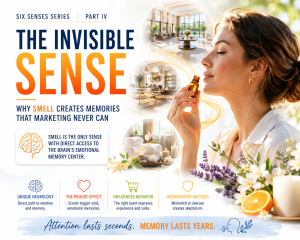
Six Senses Series | Part IV — Smell
You Can Forget a Face. You Rarely Forget a Feeling Attached to a Scent.
Imagine walking into a hotel you’ve never visited before.
The lobby is elegant.
The lighting is warm.
The music is relaxing.
Then something unexpected happens.
A subtle fragrance fills the air.
Months later…
You cannot remember the artwork on the wall.
You cannot remember the music.
You may not even remember the conversation you had at the front desk.
But if you encounter that same scent again…
You’re instantly transported back.
Not because you tried to remember.
Because your brain remembered for you.
This is the extraordinary power of smell.
It doesn’t politely knock on memory’s door.
It walks straight in.
Smell Is the Only Sense That Takes a Different Path to the Brain
Every other major sense follows a familiar neurological route before reaching areas responsible for emotion and memory.
Smell is different.
Unlike vision, hearing, and touch, olfactory information reaches brain regions involved in emotion and memory through unusually direct neural connections, including the amygdala and hippocampus. This unique anatomy helps explain why odors can trigger vivid, emotional autobiographical memories with remarkable speed.
Research Source: The Proust Effect: Scents, Food, and Nostalgia (Current Opinion in Psychology)
https://pubmed.ncbi.nlm.nih.gov/36863096/
That neurological shortcut changes everything.
We often think we remember a smell.
In reality… The smell remembers us.
The Proust Effect: When One Scent Unlocks an Entire Chapter of Your Life
Nearly everyone has experienced it.
Fresh-cut grass.
A particular perfume.
Old books.
Coffee brewing before sunrise.
Fresh baked bread.
Without warning…
You’re no longer standing where you are.
You’re standing somewhere from years ago.
Psychologists call this the Proust Effect, named after French author Marcel Proust, whose famous description of tasting a madeleine instantly released childhood memories has become one of psychology’s best-known examples of involuntary memory.
Modern neuroscience confirms that memories evoked by smell and taste are often more emotional, more vivid, more self-relevant, and more positive than memories triggered through other senses. Researchers also found these memories can strengthen feelings of meaning, social connection, and well-being.
Research Source: The Proust Effect: Scents, Food, and Nostalgia (Current Opinion in Psychology)
https://pubmed.ncbi.nlm.nih.gov/36863096/
No other sense consistently reaches that level of emotional intensity.
Why Luxury Brands Invest in a Sense You Can Barely Notice
Walk into many luxury hotels around the world.
You may notice something…
without realizing you noticed it.
Many premium hospitality and retail brands intentionally develop signature ambient scents that become part of the customer experience.
The objective isn’t to sell fragrance.
It’s to build memory.
Retail researchers have repeatedly demonstrated that congruent ambient scents influence how customers evaluate stores, merchandise, and purchasing behavior.
The key word is congruent.
The scent must naturally fit the environment.
When it does, consumers respond more positively and actual sales can improve.
Research Source: Gender-congruent Ambient Scent Influences on Approach and Avoidance Behaviors in a Retail Store (Journal of Business Research)
https://www.sciencedirect.com/science/article/pii/S0148296306001299
The greatest sensory marketing isn’t obvious. It’s almost invisible.
People Rarely Remember the Product. They Remember How the Experience Felt.
Think back to your favorite bakery.
You probably remember the smell before you remember the logo.
Think about walking into a high-end leather store.
The scent becomes part of the product.
Visit a luxury spa.
Close your eyes.
The aroma immediately becomes part of relaxation itself.
The scent isn’t decoration.
The scent becomes the experience.
The most memorable brands understand something many organizations overlook:
Customers don’t experience businesses through PowerPoint presentations.
They experience them through environments.
Smell Can Quietly Influence Behavior
Researchers have spent decades studying how ambient scent shapes consumer behavior.
One consistent finding emerges.
Appropriate scents improve evaluations of retail environments and can positively influence shopping behavior.
Studies conducted in real retail environments have shown that carefully matched ambient scents can improve customer perceptions, increase time spent in stores, and even contribute to stronger sales performance.
Research Source: Ambient Scent as a Mood Inducer in Supermarkets: The Role of Scent Intensity and Time Pressure of Shoppers (Journal of Retailing and Consumer Services)
https://www.sciencedirect.com/science/article/pii/S0969698916300546
Notice what the research does not say.
Scent is not manipulation.
Scent is amplification.
When it aligns with the brand experience, it reinforces what customers are already feeling.
When it feels artificial or out of place, the effect can disappear—or even backfire by increasing skepticism.
Research Source: Negative Effects of Ambient Scents on Consumers’ Skepticism About Retailer’s Motives (Journal of Retailing and Consumer Services)
https://www.sciencedirect.com/science/article/pii/S0969698911001226
Like every sensory strategy… Authenticity matters.
The Selling Senses Connection
In Selling Senses, smell represents something much larger than fragrance.
It represents emotional anchors.
Every interaction creates invisible associations.
A conversation.
A handshake.
A customer experience.
A presentation.
A culture.
People may forget your slide deck.
They may forget your pricing.
They may even forget your exact words.
But they rarely forget how you made them feel.
That emotional residue becomes the psychological equivalent of a signature scent.
Long after the interaction ends… The feeling remains.
What the Research Really Shows
The evidence reveals an extraordinary truth.
- Smell has a uniquely direct relationship with the brain’s emotional and memory systems.
- Odor-evoked memories are often more vivid, emotional, and personally meaningful than memories triggered by many other sensory cues.
- Congruent ambient scents can positively influence customer evaluations, shopping behavior, and purchasing decisions when they authentically match the environment.
- Poorly matched or overly obvious scent strategies can increase customer skepticism rather than trust.
Together, these findings reveal something every leader, marketer, and salesperson should remember.
People don’t merely remember information.
They remember experiences.
And sometimes… The most powerful experience is the one they never consciously noticed.
Research Sources
The scientific findings discussed throughout this article are supported by the following peer-reviewed research:
1. Green, J. D., et al.
The Proust Effect: Scents, Food, and Nostalgia.
Current Opinion in Psychology (2023)
https://pubmed.ncbi.nlm.nih.gov/36863096/
2. Spangenberg, E. R., Sprott, D. E., Grohmann, B., & Tracy, D. L.
Gender-congruent Ambient Scent Influences on Approach and Avoidance Behaviors in a Retail Store.
Journal of Business Research
https://www.sciencedirect.com/science/article/pii/S0148296306001299
3. Morrin, M., et al.
Ambient Scent as a Mood Inducer in Supermarkets: The Role of Scent Intensity and Time Pressure of Shoppers.
Journal of Retailing and Consumer Services
https://www.sciencedirect.com/science/article/pii/S0969698916300546
4. Morrin, M., et al.
Negative Effects of Ambient Scents on Consumers’ Skepticism About Retailer’s Motives.
Journal of Retailing and Consumer Services
https://www.sciencedirect.com/science/article/pii/S0969698911001226
Continue the Journey
This article is Part IV of the Six Senses Series.
If you missed Part III, continue here:
👉 https://www.sellingsenses.com/the-power-of-touch-why-people-believe-what-they-can-feel/
Touch transforms interaction into experience.
Smell transforms experience into memory.
You can also explore the complete Selling Senses blog library here:
👉 https://www.sellingsenses.com/blog/
Final Thought
The strongest brands don’t compete only for attention.
They compete for memory.
Because attention lasts seconds.
Memory lasts years.
Long after customers forget your advertisement…
Long after they forget your presentation…
Long after they forget your pricing…
They remember how your brand made them feel.
Sometimes…
All it takes is one familiar scent to bring the entire experience back to life.
Closing Question
What scent instantly transports you to another time in your life—and what does that teach us about the experiences our own brands are creating?
The Power of Touch: Why People Believe What They Can Feel
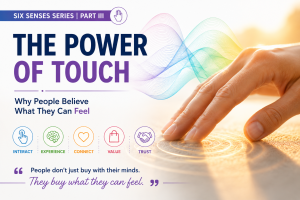
Six Senses Series | Part III — Touch
Some Experiences Cannot Be Explained. They Must Be Felt.
Imagine buying two identical coffee mugs online.
One is made from thin plastic.
The other is handcrafted ceramic with a smooth matte finish and noticeable weight.
Both hold the same amount of coffee.
Both perform the same function.
Yet the experience is completely different.
One feels disposable.
The other feels valuable.
Nothing about the product changed.
Only the feeling did.
This illustrates one of the most overlooked truths in human behavior:
People do not simply evaluate with their minds.
They evaluate with their hands.
Touch transforms information into experience.
And experience changes perception.
Touch Is One of the Brain’s Most Powerful Sources of Information
Your skin is the largest sensory organ in the human body.
Every second, millions of sensory receptors collect information about pressure, temperature, vibration, texture, and movement before transmitting those signals to the brain.
Researchers at the National Institutes of Health explain that tactile information is processed through highly specialized neural pathways that allow humans to distinguish remarkably subtle differences in texture, pressure, and shape.
Source: National Institutes of Health
👉 https://www.ncbi.nlm.nih.gov/books/NBK10986/
Touch does far more than detect contact.
It creates understanding.
People Value What They Can Touch
One of the most fascinating discoveries in behavioral economics is known as the Endowment Effect.
Researchers Daniel Kahneman, Jack Knetsch, and Richard Thaler demonstrated that people place greater value on something once they feel ownership of it.
Even brief physical interaction can increase perceived value.
Source: Nobel Prize research summarized by the University of Chicago
👉 https://www.chicagobooth.edu/review/endowment-effect
This has enormous implications for business.
When buyers interact with a product, hold it, test it, or physically experience it, they begin building psychological ownership.
Ownership increases attachment.
Attachment influences decisions.
The IKEA Effect: Why Building Creates Belief
Sometimes touching is not enough.
Sometimes creating matters even more.
Researchers Michael Norton, Daniel Mochon, and Dan Ariely discovered what became known as the IKEA Effect.
People consistently place higher value on products they help build themselves.
Even when the final product is objectively identical, participation increases perceived value.
Source: Harvard Business School
👉 https://www.hbs.edu/faculty/Pages/item.aspx?num=41101
This principle extends far beyond furniture.
When buyers help shape a solution…
When clients participate in discovery…
When customers contribute ideas…
They begin investing emotionally.
Participation creates ownership.
Ownership creates commitment.
Touch Creates Emotional Connection
Touch is not merely physical.
It is emotional.
Research published in Science found that physical warmth influences social perception.
Participants holding a warm cup of coffee were more likely to perceive others as warm and trustworthy than participants holding a cold beverage.
This phenomenon demonstrates how physical sensations can shape interpersonal judgments.
Source: Science
👉 https://www.science.org/doi/10.1126/science.1162548
Although context always matters, the study reminds us that the brain constantly integrates physical experiences into emotional interpretations.
We do not simply feel objects.
We often feel relationships.
Digital Businesses Still Need Touch
Today’s buyers spend more time behind screens than ever before.
Many purchases occur without ever entering a store.
Yet the need for tactile experiences has not disappeared.
Instead, organizations have become increasingly intentional about creating digital experiences that simulate confidence through motion, responsiveness, animation, texture, packaging, and product presentation.
Even luxury brands invest heavily in packaging because the first physical interaction often reinforces—or undermines—the promise made online.
The buying journey may begin digitally.
Trust often becomes tangible.
The Selling Senses Connection
In Selling Senses, touch extends far beyond physical contact.
Touch represents interaction.
Engagement.
Participation.
Experience.
A buyer who actively participates remembers more than one who passively observes.
A customer who experiences value often believes more deeply than one who simply hears about it.
The strongest sales experiences are rarely lectures.
They are collaborations.
They invite buyers to interact, explore, test, imagine, and experience.
That is where belief begins.
What the Research Really Shows
The evidence consistently points toward one conclusion.
- Touch activates sophisticated neural pathways dedicated to understanding the physical world.
- Physical interaction increases perceived ownership and value.
- Participation strengthens emotional investment.
- Physical sensations can influence interpersonal judgments and trust.
Together, these findings reveal something every leader, marketer, and salesperson should remember.
People don’t simply believe what they hear.
They believe what they experience.
Continue the Journey
This article is Part III of the Six Senses Series.
If you missed Part II, continue here:
Sound builds trust.
Touch transforms trust into experience.
You can also explore the complete Selling Senses blog library here:
👉 https://www.sellingsenses.com/blog/
Final Thought
Long before people become loyal to a brand…
They interact with it.
Sometimes through a handshake.
Sometimes through a product.
Sometimes through a package.
Sometimes through an experience.
Every interaction leaves an impression.
The question is:
What does your customer feel when they experience your brand?
Closing Question
Think about the last product or experience that truly impressed you. Was it what you saw—or was it what you felt when you held it, used it, or experienced it?
The Science of Sound: Why Your Brain Feels a Voice Before It Understands the Words
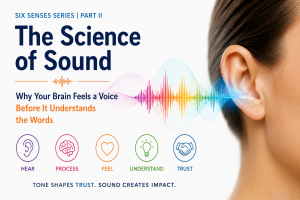
Six Senses Series | Part II — Hearing
You Hear More Than Words
Imagine answering two phone calls.
The first voice says,
“I’m really glad you called.”
The words are positive.
But the tone feels rushed, flat, and distracted.
The second voice says exactly the same sentence.
This time the voice sounds warm, relaxed, and genuinely happy.
The words never changed.
Your experience did.
Why?
Because the human brain processes far more than language.
It processes tone, pitch, rhythm, pace, pauses, and vocal emotion—often before it consciously interprets meaning.
That realization changes how we think about communication.
Buyers are not simply listening to what we say.
They are sensing how we say it.
Your Brain Has Specialized Regions Just for Human Voices
The human brain treats voices differently from every other sound.
Researchers have identified specialized “voice-selective” regions in the auditory cortex dedicated specifically to recognizing human voices and extracting socially important information.
These regions help us rapidly identify age, gender, identity, emotional state, and intention—often without consciously realizing it.
Source: NIH – The Developmental Origins of Voice Processing in the Human Brain
👉 https://pmc.ncbi.nlm.nih.gov/articles/PMC2852650/
More recent neuroscience research from the University of Pittsburgh found additional brain regions specifically recognize non-speech vocal sounds such as laughter, crying, sighs, coughing, and gasps because these sounds immediately communicate human emotion and intent.
Source: University of Pittsburgh
👉 https://www.upmcphysicianresources.com/news/072822-brain-regions
Before buyers fully understand our message… Their brain has already begun understanding us.
Your Voice Communicates Emotion Faster Than Your Words
Think about the last time someone said,
“I’m fine.”
Were they?
Sometimes yes.
Often no.
Because emotion frequently lives inside the voice rather than inside the words.
Researchers studying emotional prosody—the emotional qualities carried through speech—have found that listeners automatically decode changes in pitch, loudness, rhythm, speech rate, and pauses to understand emotion.
Even when the words remain identical, the emotional interpretation changes dramatically.
Source: NIH Review on Voice Processing
👉 https://pmc.ncbi.nlm.nih.gov/articles/PMC2852650/
Your voice constantly answers questions buyers may never ask aloud:
Can I trust you?
Do you believe what you’re saying?
Are you confident?
Are you present?
The answers often arrive before logic has a chance to respond.
Emotion Lives in the Sound, Not Just the Sentence
Scientists refer to this phenomenon as emotional prosody.
It explains why sarcasm works.
Why encouragement feels different from instruction.
Why one presentation energizes an audience while another puts them to sleep.
Research published in Brain Stimulation demonstrated that the right superior temporal gyrus plays a critical role in decoding emotional tone in speech, showing that the brain processes emotional vocal information through specialized neural pathways.
Source: Brain Stimulation
This reminds us of an important truth.
People hear our emotions long before they analyze our message.
Silence Is One of the Most Powerful Sounds
Many people think communication is about speaking.
Great communicators understand it is also about pausing.
Silence creates space.
Space creates reflection.
Reflection creates understanding.
When every sentence runs together without pause, the brain has less opportunity to organize information.
Strategic pauses allow ideas to settle while increasing anticipation for what comes next.
The best speakers, storytellers, teachers, and sales professionals understand this instinctively.
Sometimes the most influential moment in a conversation is the moment when nothing is said.
Music Quietly Changes Human Behavior
Hearing influences more than conversations.
It shapes environments.
One of the most influential studies in consumer psychology found that slower background music encouraged shoppers to move more slowly through stores and increased sales compared with faster music.
The music did not change the products.
It changed the experience.
Source: Ronald Milliman, Journal of Marketing
👉 https://psycnet.apa.org/record/1983-20937-001
The implication reaches far beyond retail.
Everything buyers hear contributes to how an experience feels.
The Sound of Leadership
Leadership is also heard before it is evaluated.
A calm voice communicates confidence.
A hurried voice communicates urgency.
A hesitant voice communicates uncertainty.
A steady voice communicates stability.
Leaders rarely inspire people through information alone.
They inspire through conviction.
And conviction has a sound.
Whether leading a sales meeting, coaching a team, delivering a keynote, or recording a podcast, your voice becomes part of your leadership brand.
The Selling Senses Connection
In Selling Senses, hearing extends far beyond listening.
Blog #12 explored why sellers must become better listeners.
This article explores the other side of the conversation:
What buyers hear when we speak.
The eye may capture attention.
The ear often builds trust.
Every conversation carries two messages.
The spoken message.
And the emotional message.
The most effective communicators align both.
Because when words and tone work together, buyers experience authenticity.
And authenticity builds confidence.
What the Research Really Shows
The evidence points toward an extraordinary conclusion:
- The human brain contains specialized regions dedicated to processing voices.
- Vocal emotion is decoded through dedicated neural systems before listeners consciously evaluate meaning.
- Sound influences behavior, emotion, and even purchasing activity.
- Tone, rhythm, pacing, and pauses all contribute to how messages are interpreted.
Together, these findings reveal something every leader, marketer, and sales professional should remember.
People do not simply hear information.
They hear confidence.
They hear uncertainty.
They hear authenticity.
They hear emotion.
Long before they decide whether to believe the message…
They have already begun interpreting the messenger.
Continue the Journey
This article is Part II of the Six Senses Series.
If you missed Part I, continue here:
Sight captures attention.
Sound gives that attention meaning.
You can also explore the complete Selling Senses blog library here:
👉 https://www.sellingsenses.com/blog/
Final Thought
Every conversation has two voices.
The one formed by words.
And the one formed by emotion.
Buyers hear both.
The question is…
Which one are they believing?
Closing Question
Think about someone whose voice immediately earns your trust. What is it about the way they speak—not what they say—that makes you believe them?
The Power of Sight: Why Your Brain Decides Before You Read a Single Word
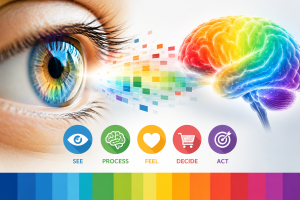
Introducing the Six Senses Series: Part I — Vision
You See Before You Think
Long before a buyer reads your headline…
Before they evaluate your product…
Before they compare pricing…
Their brain has already begun making judgments.
It happens almost instantly.
Vision is the dominant human sense. Every second, your eyes deliver an extraordinary amount of information to the brain, allowing it to recognize patterns, assess environments, and make rapid judgments about what deserves attention.
For sales professionals, marketers, and business leaders, this creates an important reality.
People experience your message long before they process your message.
That experience begins with what they see.
The Brain Processes Visual Information at Incredible Speed
Scientists estimate that nearly 50% of the human brain is involved in visual processing, making vision one of our most influential senses.
Researchers at the Massachusetts Institute of Technology also discovered that the human brain can identify the content of an image in as little as 13 milliseconds.
Think about that.
In less time than it takes to blink, your brain has already started interpreting the world around you.
Source: MIT News
https://news.mit.edu/2014/in-the-blink-of-an-eye-0116
First Impressions Happen Faster Than We Think
Psychologists have long studied first impressions.
Research from Princeton University found that people form impressions of faces in approximately 100 milliseconds, including judgments related to trustworthiness and competence.
Source: Princeton University
https://www.princeton.edu/news/2006/02/28/first-impressions
While products are not faces, the principle is remarkably similar.
Buyers begin evaluating:
- professionalism
- quality
- credibility
- trust
before they consciously analyze details.
That means every visual element communicates.
Whether you intend it to or not.
Color Does More Than Make Things Beautiful
Many people think color is simply decoration.
Neuroscience tells a different story.
Color influences attention, emotion, perception, and behavior.
A comprehensive review published in the Annual Review of Psychology concluded that color can affect psychological functioning through both learned associations and biological responses, while emphasizing that context matters greatly. (PMC)
One color can communicate energy.
Another can communicate calm.
One can create urgency.
Another can communicate trust.
Color is not simply seen.
It is experienced.
People Judge Faster Than They Realize
Marketing research has repeatedly shown the importance of visual design.
Studies cited by the University of Southern California note that consumers often form an initial impression of a product within 90 seconds, and that up to 90% of that initial assessment may be influenced by color, depending on the context. (appliedpsychologydegree.usc.edu)
That statistic should cause every business leader to pause.
If your colors communicate confusion…
Your message may never receive a fair evaluation.
If your visual presentation communicates confidence…
The conversation begins differently.
Blue, Red, Green… Why Different Colors Feel Different
Although color associations vary across cultures and situations, decades of research have identified common patterns.
🔵 Blue is frequently associated with trust, stability, and reliability.
🔴 Red naturally attracts attention and can increase physiological arousal, making it effective for urgency and action.
🟢 Green is commonly linked with balance, growth, and restoration.
🟡 Yellow often communicates optimism and energy, although excessive use can contribute to visual fatigue.
Researchers caution that these effects depend heavily on context, audience, and culture rather than representing universal rules. (PMC)
The lesson is simple.
Color should never be accidental.
Vision Creates Emotional Expectations
Before someone ever speaks to you…
They have already started creating expectations.
The colors you choose…
The lighting…
The photography…
The typography…
The layout…
The spacing…
The visual harmony…
Every element quietly answers one question:
“How does this experience feel?”
That feeling becomes the foundation upon which logic is built.
The Selling Senses Connection
This is precisely why Selling Senses begins with the senses.
The buyer is not simply evaluating information.
They are experiencing information.
Vision becomes the doorway.
Before buyers trust your expertise…
They experience your design.
Before they believe your claims…
They experience your brand.
Before they evaluate your value…
They experience your presence.
What they see shapes what they expect.
What they expect influences what they believe.
And what they believe often influences what they buy.
What the Research Really Shows
The evidence is remarkably consistent.
- Nearly half of the brain participates in visual processing.
- The brain can recognize images in as little as 13 milliseconds.
- People form first impressions in approximately 100 milliseconds.
- Color significantly influences perception, attention, and emotional response.
None of these findings suggest color alone determines buying decisions.
However, they demonstrate something equally important.
Visual experiences shape the environment in which decisions are made.
For sellers, leaders, entrepreneurs, and marketers, that distinction matters.
Because buyers do not only hear your message.
They see it first.
Continue the Journey
This article begins a brand-new Six Senses Series exploring how each sense influences human perception, trust, and buying behavior.
If you missed the previous articles in the Selling Senses series, explore them here:
👉 https://www.sellingsenses.com/blog/
For a deeper look at how memorable experiences influence buyer behavior, continue with Blog #13:
Memory begins with attention.
Attention often begins with what we see.
Final Thought
We often say,
“Don’t judge a book by its cover.”
Yet neuroscience reminds us that the brain is constantly making rapid visual judgments.
The question is not whether buyers make first impressions.
They do.
The real question is: What is your brand communicating before anyone reads your first sentence?
Closing Question
When you visit a website, open a presentation, or walk into a business for the first time, what visual element shapes your opinion before a single word is spoken?
