The Memory Advantage: Why Buyers Remember Experiences Long After They Forget Your Pitch
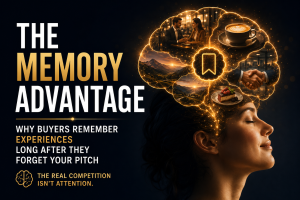
The Real Competition Isn’t Attention!
Attention Is Only the Beginning
Much of modern sales and marketing revolves around one objective: capturing attention.
Organizations invest millions of dollars trying to stand out in crowded markets. They compete for clicks, views, impressions, and engagement. Entire strategies are built around earning a few moments of a prospect’s focus.
Attention matters.
Without it, conversations never begin.
However, attention is not where lasting influence is created.
The more important question is what happens after the meeting ends. What remains in the buyer’s mind days, weeks, or even months later? What do they remember when a competitor reaches out? What thoughts return when they are finally ready to make a decision?
Because while attention may open the door, memory often determines whether the relationship continues.
The organizations that understand this distinction gain a powerful advantage. They stop focusing solely on being noticed and start focusing on being remembered.
Memory Shapes More Decisions Than We Realize
Most people think decisions happen in the present moment.
In reality, many decisions are influenced by experiences stored in memory.
Every interaction leaves an impression. Every conversation creates an emotional response. Every customer experience becomes part of the mental library buyers use when evaluating future choices.
When someone is deciding between two similar products or services, they often rely on more than logic. They unconsciously reference previous experiences and the emotions attached to them.
Neuroscientist Antonio Damasio’s Somatic Marker Hypothesis suggests that emotions help guide decision making by attaching value to previous experiences.
👉 https://en.wikipedia.org/wiki/Somatic_marker_hypothesis
In simple terms, people do not just remember what happened.
They remember how it felt.
And those feelings often influence future decisions long after the original experience has ended.
Why Emotion Leaves a Lasting Mark
Not every moment receives equal treatment from the brain.
Some experiences disappear quickly.
Others remain vivid for years.
Research published by the National Institutes of Health found that emotionally significant experiences are remembered better than neutral ones.
👉 https://pmc.ncbi.nlm.nih.gov/articles/PMC4336713/
Think about your own life.
You may struggle to remember what you ate three Tuesdays ago.
Yet you probably remember the excitement of a major achievement, the joy of a meaningful celebration, or the disappointment of a painful setback.
Emotion acts like a highlighter for memory.
This has important implications for sales.
Buyers rarely remember every feature discussed during a presentation. They often forget technical details, pricing comparisons, and product specifications.
However, they frequently remember how the conversation made them feel.
Did they feel understood?
Did they feel pressured?
Did they feel valued?
Did they feel confident?
Those emotional impressions often become the memories that matter most.
Why Stories Outperform Facts
Most sales presentations are built around information.
Features.
Benefits.
Specifications.
Capabilities.
Those elements are important, but information alone does not always create memorable experiences.
Research from Stanford Graduate School of Business found that stories can be remembered up to 22 times more than facts alone because stories create emotional engagement and meaning.
👉 https://www.gsb.stanford.edu/insights/why-your-brain-loves-good-story
This explains why people often remember a story years after they have forgotten the supporting data.
Stories create context.
Stories create emotion.
Stories help people see themselves within the experience.
The most memorable communicators understand this intuitively. They do not simply transfer information. They create meaning.
That meaning becomes memory.
The Powerful Connection Between the Senses and Memory
Few things demonstrate the power of memory more clearly than the senses.
A familiar scent can instantly transport someone back to childhood.
A song can bring back memories from decades earlier.
A visual image can remain vivid long after countless other details have disappeared.
Research from Rockefeller University explains that smell has an unusually strong connection to memory because olfactory pathways connect directly to emotional and memory centers in the brain.
👉 https://www.rockefeller.edu/news/18439-why-smells-trigger-strong-memories/
This is one of the reasons sensory experiences can be so powerful.
The senses do more than collect information.
They help store experiences.
And stored experiences influence future behavior.
When organizations intentionally create positive sensory experiences, they are not simply enhancing the moment.
They are helping shape what customers will remember later.
Customer Experience Is Really a Memory Strategy
Many organizations view customer experience as a service initiative.
In reality, it is also a memory strategy.
Every interaction leaves behind something.
According to PwC research:
- 73% of consumers say customer experience is an important factor in purchasing decisions
- 65% say a positive experience is more influential than great advertising
- 42% would pay more for a friendly and welcoming experience
These findings reveal a critical insight.
People do not simply compare products.
They compare experiences.
And those experiences become memories that shape future decisions.
The strongest brands are not always the ones with the biggest marketing budgets.
Often, they are the ones that create the most memorable experiences.
The Competitive Advantage Most Companies Miss
Products can be copied.
Features can be matched.
Pricing can be undercut.
Experiences are far more difficult to duplicate.
A competitor can replicate what you sell.
They cannot easily replicate how you make people feel.
That is why memorable experiences become strategic assets.
When buyers remember feeling understood, respected, and valued, they become more likely to return.
They become more likely to refer others.
They become more likely to trust.
In many cases, the memory of the experience becomes more valuable than the product itself.
The Selling Senses Connection
This idea sits at the heart of Selling Senses.
The goal is not simply to communicate information.
The goal is to create meaningful experiences that remain long after the interaction ends.
Trust grows through experiences.
Relationships deepen through experiences.
Loyalty develops through experiences.
And experiences become memories.
When buyers remember the experience, they remember the relationship.
When they remember the relationship, trust lasts longer.
When trust lasts longer, opportunities multiply.
The most effective sellers are not always the most persuasive.
They are often the most memorable.
What the Research Really Shows
The evidence points toward a simple but powerful conclusion.
People forget information surprisingly quickly.
Experiences tend to last much longer.
Features become blurry.
Presentations fade.
Specifications are replaced by newer information.
Yet emotional memories often remain.
What people remember most is not always what was said.
It is how they felt while it was being said.
That distinction changes the way we think about influence.
Because being remembered is often more valuable than being noticed.
Go Deeper
If you enjoyed this article, continue with:
👉 https://www.sellingsenses.com/the-evidence-behind-sensory-selling-what-the-data-actually-shows/
This article explores the research behind sensory experiences and why they influence buyer behavior in the first place.
Final Thought
Most sellers spend their time asking:
“How do I get the buyer’s attention?”
A better question might be:
“What will they remember after I leave?”
Because attention starts the conversation.
Memory determines whether it continues.
Closing Question
Think about the last exceptional customer experience you had. What do you remember most: the product itself, or how the experience made you feel?
