The Friction Effect: Why Buyers Walk Away When Decisions Feel Too Hard
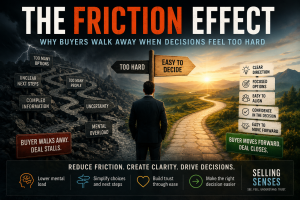
The hidden reason clarity, simplicity, and sensory ease move deals forward!
The Sale Is Not Always Lost to a Competitor
Most sellers assume a lost deal went somewhere else.
A competitor had a lower price.
Another provider offered better features.
The timing was wrong.
The buyer changed priorities.
Sometimes that is true.
However, many deals are not lost to a competitor at all.
They are lost to friction.
The decision felt too complicated. The buyer had too many options to compare, too many people to align, too much information to sort through, or too much uncertainty to resolve. Eventually, the easiest decision became no decision.
That is the hidden danger many sales teams overlook.
A confused buyer does not always say no.
Often, they simply stop moving.
Buyers Are Already Carrying Too Much Mental Load
Modern buyers are not short on information.
They are buried in it.
They research before meetings. They compare vendors before conversations. They gather opinions from colleagues, review websites, analyst reports, internal stakeholders, and artificial intelligence tools before they ever speak with a seller.
By the time they enter the sales conversation, they may already be tired.
Gartner research shows that many B2B buyers now prefer a rep-free sales experience, yet self-service digital purchases are more likely to result in purchase regret. Gartner also emphasizes the need for the right blend of digital and human interaction in complex buying decisions.
👉 https://www.gartner.com/en/sales/insights/b2b-buying-journey
That tells us something important.
Buyers may want independence, but they still need guidance.
They may want control, but they still need clarity.
They may want information, but they still need confidence.
This is where sensory selling becomes powerful. The seller is not there simply to add more information. The seller is there to reduce the buyer’s mental load and help the decision feel clearer, safer, and easier to move through.
More Information Does Not Always Create More Confidence
Many sellers respond to uncertainty by adding more.
More slides.
More proof points.
More follow-up emails.
More comparisons.
More explanations.
The intention is helpful.
The impact can be overwhelming.
Harvard Business Review’s article To Keep Your Customers, Keep It Simple found that the single strongest driver of customer “stickiness” was decision simplicity. In other words, customers are more likely to follow through, repurchase, and recommend when they can gather trustworthy information and compare options easily.
👉 https://hbr.org/2012/05/to-keep-your-customers-keep-it-simple
That finding should change how sellers think.
The goal is not to say everything.
The goal is to make the right things easier to understand.
When buyers feel mentally overloaded, they do not become more confident. They become more cautious. They slow down, postpone, involve more people, or retreat into silence.
Clarity does not come from volume.
Clarity comes from reduction.
Too Many Choices Can Quietly Kill Momentum
Choice feels empowering at first.
Buyers like options. They want flexibility. They want to feel in control.
However, too many choices can create paralysis.
In the well-known jam study by Sheena Iyengar and Mark Lepper, shoppers were more attracted to a display with 24 jam options than one with 6. Yet shoppers were much more likely to purchase when they encountered only 6 options. The study showed that extensive choice can attract attention while reducing actual decision making.
👉 https://faculty.washington.edu/jdb/345/345%20Articles/Iyengar%20%26%20Lepper%20%282000%29.pdf
This applies directly to sales.
When a seller presents too many packages, options, features, paths, or next steps, the buyer may appear engaged on the surface. They may ask questions. They may request more information.
But inside, the decision may be getting heavier.
The buyer is not always asking for more because more will help.
Sometimes they ask for more because they are still searching for certainty.
That is why great sellers do not overwhelm buyers with every possible route. They help buyers identify the right route.
Friction Is a Sensory Experience
Friction is not only logical.
It is felt.
A buyer can sense when a conversation is too complicated. They can feel when a proposal is difficult to follow. They can experience tension when options blur together or when the next step feels unclear.
This is why friction matters so much in Selling Senses.
The buying experience has a sensory texture.
Some conversations feel smooth.
Some feel heavy.
Some feel clear.
Some feel exhausting.
The best sellers notice this.
They sense when a buyer’s energy drops. They notice when the room becomes quiet for the wrong reason. They recognize when curiosity turns into cognitive strain.
That moment matters.
Because once the decision begins to feel hard, the buyer may start looking for relief instead of progress.
The Checkout Lesson Applies Beyond Ecommerce
Friction is easy to see in ecommerce because the numbers are visible.
Baymard Institute has tracked online cart abandonment for years and reports that the average cart abandonment rate is around 70%. Baymard also reports that 18% of U.S. online shoppers have abandoned an order because the checkout process was too long or complicated.
👉 https://baymard.com/lists/cart-abandonment-rate
While sales conversations are not checkout pages, the lesson still applies.
When the process feels difficult, people leave.
In sales, buyers may not abandon a cart, but they abandon momentum.
They delay the next meeting. They stop responding. They ask to revisit next quarter. They say they need to “circle back internally.”
Sometimes those are real constraints.
Other times, they are signs of friction.
The process has become too heavy to continue.
Simplicity Builds Trust
Simplicity is often misunderstood.
It does not mean shallow.
It does not mean basic.
It does not mean avoiding complexity.
Simplicity means helping buyers find order inside complexity.
A great seller does not pretend the decision is easy when it is not. Instead, they help the buyer see the decision clearly. They organize the noise. They name the real tradeoffs. They explain what matters and what does not.
That kind of simplicity builds trust.
It tells the buyer:
You are safe here.
You do not have to figure this out alone.
I can help you make sense of it.
This is where IQ, EQ, and SQ align.
IQ helps the seller understand the complexity.
EQ helps the seller sense the buyers overwhelm.
SQ helps the seller guide with integrity instead of pressure.
That is sensory alignment in action.
The Best Sellers Reduce Effort
The best sellers do not make buyers work harder to understand.
They make the decision easier to carry.
They summarize clearly. They simplify next steps. They reduce unnecessary choices. They confirm what matters most. They help the buyer feel organized instead of overloaded.
This is not manipulation.
It is service.
The buyer still makes the decision. The seller simply helps remove unnecessary friction from the path.
Research on customer effort has long shown that reducing effort matters. Harvard Business Review’s work on customer service found that reducing the work customers must do to solve their problems is a major driver of loyalty.
👉 https://hbr.org/2010/07/stop-trying-to-delight-your-customers
The same principle applies in sales.
The easier it is for buyers to understand, trust, and act, the more likely they are to move forward.
What This Means for Sales Conversations
If buyers are stalling, the issue may not be value.
It may be friction.
The proposal may be too dense.
The next step may be unclear.
The business case may be too hard to explain internally.
The buyer may not know how to compare the options.
The decision may feel mentally exhausting.
Instead of asking, “How do I convince them?”
A better question may be:
“What is making this decision feel harder than it needs to be?”
That question changes the conversation.
It moves the seller from pressure to partnership.
It shifts the focus from closing the buyer to helping the buyer.
And that is where trust grows.
The Selling Senses Connection
Selling Senses is built on the idea that buyers respond to more than information.
They respond to experience.
A buying process can feel smooth or stressful. A conversation can feel clarifying or confusing. A proposal can feel helpful or heavy.
These feelings matter because they shape decisions.
When sellers reduce friction, they create sensory ease.
The buyer feels calmer.
The path feels clearer.
The risk feels more manageable.
The decision feels less overwhelming.
That does not guarantee a yes.
But it creates the conditions where a real yes becomes possible.
What the Research Really Shows
The research points toward a simple truth.
Buyers do not always need more information.
Often, they need less friction.
Decision simplicity increases customer stickiness. Too many choices can reduce action. Complicated processes cause people to abandon purchases. Lower effort improves loyalty.
Together, these findings reveal a powerful lesson for modern sales:
The easiest decision to understand often becomes the easiest decision to trust.
And the easiest decision to trust is the one most likely to move forward.
Go Deeper
If you enjoyed this article, continue with:
Listening helps sellers detect the friction buyers do not always know how to explain.
Final Thought
Buyers rarely say:
“This decision feels cognitively overloaded.”
They say:
“Let me think about it.”
“Send me more information.”
“We need to discuss internally.”
“Let’s revisit later.”
Sometimes those statements are necessary.
But sometimes they are signals.
The buyer is not rejecting the solution.
The buyer is struggling with the weight of the decision.
Closing Question
Where in your sales process are you creating friction without realizing it?
