The Hidden Link Between Spirituality and Performance: What the Research Actually Shows
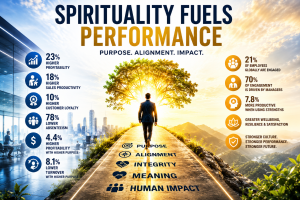
Why meaning, purpose, and spiritual alignment improve engagement, leadership, and sales performance!
The Question Most Workplaces Avoid
For decades, performance has been measured through visible output.
Revenue generated.
Deals closed.
Hours worked.
Productivity metrics.
Those measurements matter.
However, they do not fully explain why some people consistently perform at a higher level while others burn out, disengage, or lose motivation.
Behind performance sits something deeper.
Meaning.
Purpose.
Belief.
Connection.
That is where spirituality enters the conversation.
Not as religion forced into business.
Instead, as the search for meaning, alignment, integrity, purpose, and human connection.
Research on workplace spirituality consistently connects these factors with stronger wellbeing, engagement, satisfaction, and performance outcomes.
👉 https://pmc.ncbi.nlm.nih.gov/articles/PMC12449368/
Spirituality and Performance Are More Connected Than Most People Realize
Many organizations separate spirituality from performance.
Human beings do not.
The same person who brings skill to work also brings values, fears, beliefs, emotions, and purpose.
When those inner dimensions are disconnected, performance often becomes mechanical.
When they are aligned, something changes.
People become more resilient.
More committed.
More engaged.
More energized.
Research on workplace spirituality and employee performance found a significant positive relationship between spirituality, engagement, and measurable performance outcomes.
👉 https://ijsshr.in/v7i10/Doc/51.pdf
This matters because pressure alone cannot sustain high performance long term.
Meaning can.
Purpose Has Measurable Business Impact
Purpose is not just motivational language.
It has measurable organizational impact.
When employees feel connected to a meaningful mission, they invest more emotionally in the work. They persist longer during challenges and contribute with greater intention.
Gallup research found that a 10% improvement in employees’ connection to their organization’s mission or purpose led to:
- 8.1% lower turnover
- 4.4% higher profitability
👉 https://www.gallup.com/workplace/350060/people-best-performance-start-purpose.aspx
That is not theory. That is measurable business performance.
Purpose does not replace strategy. It strengthens execution.
Engagement Is One of the Strongest Performance Drivers
Spirituality at work often reveals itself through engagement.
When people believe their work matters, they become emotionally invested.
They stop working only for tasks and begin working with meaning.
Gallup’s State of the Global Workplace report found:
- Only 21% of employees globally are engaged
- Low engagement continues to cost the global economy trillions in lost productivity
👉 https://www.gallup.com/workplace/349484/state-of-the-global-workplace.aspx
At the same time, Gallup research shows highly engaged teams experience:
- 23% higher profitability
- 18% higher sales productivity
- 10% higher customer loyalty
- 78% lower absenteeism
👉 https://www.gallup.com/workplace/236366/right-culture-not-employee-satisfaction.aspx
Those numbers are impossible to ignore.
Disengagement is not just emotional. It is expensive.
Managers and Leaders Shape Emotional Energy
Leadership plays a massive role in engagement and performance.
Managers do more than oversee tasks.
They shape emotional climate.
They influence whether people feel:
- valued
- connected
- trusted
- inspired
Gallup research has shown managers account for approximately 70% of the variance in team engagement.
That statistic reveals something powerful:
Leadership energy directly impacts workplace performance.
This is why spiritual leadership matters!
Spiritual Leadership Produces Stronger Outcomes
Spiritual leadership focuses on:
- vision
- hope
- faith
- meaning
- belonging
- purpose
In other words, it gives people a reason to care beyond compensation alone.
Research published in Frontiers in Psychology found spiritual leadership positively impacts:
- employee task performance
- innovation
- knowledge sharing
- organizational commitment
👉 https://pmc.ncbi.nlm.nih.gov/articles/PMC6328445/
This becomes especially important in high-pressure environments like sales.
Because quotas alone do not inspire people long term. Belief does.
Spirituality Impacts Sales Performance Too
Sales is deeply emotional work.
Salespeople face:
- rejection
- uncertainty
- pressure
- competition
- emotional fatigue
To sustain high performance, they need more than product knowledge.
They need resilience.
Purpose.
Integrity.
Inner alignment.
Research focused on sales professionals found spirituality at work was positively related to:
- job satisfaction
- commitment
- retention
👉 https://journals.sagepub.com/doi/10.1177/097168581001600203
Another study found spiritual leadership positively influences adaptive selling behavior, which supports stronger customer relationships and loyalty.
👉 https://www.sciencedirect.com/science/article/abs/pii/S0148296324001528
This connects directly to Selling Senses.
Great sellers do not simply push information.
They sense emotion.
They read energy.
They adapt.
They align.
That is spiritual intelligence in action.
Strengths, Meaning, and Human Potential Are Connected
People perform better when they understand and use what is strongest within them.
That is where self-awareness and spirituality intersect.
Gallup research found:
- Employees who focus on their strengths daily are 7.8% more productive
- Teams that focus on strengths every day show 12.5% greater productivity
👉 https://www.gallup.com/workplace/231605/employees-strengths-company-stronger.aspx
The deeper lesson is not just productivity. It is alignment.
When people align their work with their values, strengths, and purpose, performance becomes more sustainable.
Faith and Spirituality Build Resilience
Performance is tested most under pressure.
A difficult quarter.
A lost deal.
A major setback.
Burnout.
Faith and spirituality often become anchors during those moments.
They create perspective.
They reduce emotional collapse.
They help people separate identity from temporary outcomes.
Research continues to connect spirituality with stronger mental health, wellbeing, resilience, and life satisfaction.
👉 https://pmc.ncbi.nlm.nih.gov/articles/PMC12449368/
In demanding professions like sales and leadership, resilience is not optional.
It is essential!
The Selling Senses Connection
This is exactly why spiritual intelligence sits at the top of the Sensory Alignment Pyramid.
IQ (Intelligence Quotient) provides knowledge.
EQ (Emotional Intelligence) creates empathy.
SQ (Spiritual Intelligence) provides:
- purpose
- integrity
- intuition
- alignment
Without IQ, credibility weakens.
Without EQ, connection weakens.
Without SQ, direction weakens.
Spirituality does not make performance less practical.
It makes performance more human.
It helps leaders inspire.
It helps sellers connect.
It helps teams persevere.
It helps people work with meaning instead of survival alone.
That changes performance at every level.
What the Research Really Shows
The data does not suggest spirituality magically creates success.
It suggests something more important.
People perform better when they feel connected to meaning.
Teams become stronger when purpose becomes personal.
Leaders create better outcomes when they build trust, hope, and belonging.
Salespeople perform better when work aligns with deeper values.
In other words: Spirituality strengthens the inner conditions performance depends on.
Go Deeper
If you want to explore how trust, perception, emotional intelligence, and alignment shape decision making and performance:
👉 https://www.sellingsenses.com/the-breakthrough-truth-about-trust-why-sensory-alignment-wins-sales/
Final Thought
Performance is not only about what people do.
It is also about what drives them.
Skill matters.
Strategy matters.
Discipline matters.
However, when those qualities become anchored in meaning, purpose, and alignment, performance changes.
People do not just work harder. They work deeper.
Closing Question
How does purpose influence the way you lead, sell, and show up every day?
