The Invisible Sense: Why Smell Creates Memories That Marketing Never Can
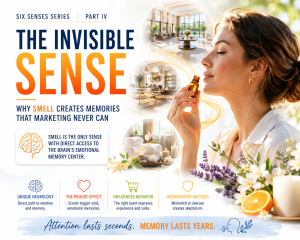
Six Senses Series | Part IV — Smell
You Can Forget a Face. You Rarely Forget a Feeling Attached to a Scent.
Imagine walking into a hotel you’ve never visited before.
The lobby is elegant.
The lighting is warm.
The music is relaxing.
Then something unexpected happens.
A subtle fragrance fills the air.
Months later…
You cannot remember the artwork on the wall.
You cannot remember the music.
You may not even remember the conversation you had at the front desk.
But if you encounter that same scent again…
You’re instantly transported back.
Not because you tried to remember.
Because your brain remembered for you.
This is the extraordinary power of smell.
It doesn’t politely knock on memory’s door.
It walks straight in.
Smell Is the Only Sense That Takes a Different Path to the Brain
Every other major sense follows a familiar neurological route before reaching areas responsible for emotion and memory.
Smell is different.
Unlike vision, hearing, and touch, olfactory information reaches brain regions involved in emotion and memory through unusually direct neural connections, including the amygdala and hippocampus. This unique anatomy helps explain why odors can trigger vivid, emotional autobiographical memories with remarkable speed.
Research Source: The Proust Effect: Scents, Food, and Nostalgia (Current Opinion in Psychology)
https://pubmed.ncbi.nlm.nih.gov/36863096/
That neurological shortcut changes everything.
We often think we remember a smell.
In reality… The smell remembers us.
The Proust Effect: When One Scent Unlocks an Entire Chapter of Your Life
Nearly everyone has experienced it.
Fresh-cut grass.
A particular perfume.
Old books.
Coffee brewing before sunrise.
Fresh baked bread.
Without warning…
You’re no longer standing where you are.
You’re standing somewhere from years ago.
Psychologists call this the Proust Effect, named after French author Marcel Proust, whose famous description of tasting a madeleine instantly released childhood memories has become one of psychology’s best-known examples of involuntary memory.
Modern neuroscience confirms that memories evoked by smell and taste are often more emotional, more vivid, more self-relevant, and more positive than memories triggered through other senses. Researchers also found these memories can strengthen feelings of meaning, social connection, and well-being.
Research Source: The Proust Effect: Scents, Food, and Nostalgia (Current Opinion in Psychology)
https://pubmed.ncbi.nlm.nih.gov/36863096/
No other sense consistently reaches that level of emotional intensity.
Why Luxury Brands Invest in a Sense You Can Barely Notice
Walk into many luxury hotels around the world.
You may notice something…
without realizing you noticed it.
Many premium hospitality and retail brands intentionally develop signature ambient scents that become part of the customer experience.
The objective isn’t to sell fragrance.
It’s to build memory.
Retail researchers have repeatedly demonstrated that congruent ambient scents influence how customers evaluate stores, merchandise, and purchasing behavior.
The key word is congruent.
The scent must naturally fit the environment.
When it does, consumers respond more positively and actual sales can improve.
Research Source: Gender-congruent Ambient Scent Influences on Approach and Avoidance Behaviors in a Retail Store (Journal of Business Research)
https://www.sciencedirect.com/science/article/pii/S0148296306001299
The greatest sensory marketing isn’t obvious. It’s almost invisible.
People Rarely Remember the Product. They Remember How the Experience Felt.
Think back to your favorite bakery.
You probably remember the smell before you remember the logo.
Think about walking into a high-end leather store.
The scent becomes part of the product.
Visit a luxury spa.
Close your eyes.
The aroma immediately becomes part of relaxation itself.
The scent isn’t decoration.
The scent becomes the experience.
The most memorable brands understand something many organizations overlook:
Customers don’t experience businesses through PowerPoint presentations.
They experience them through environments.
Smell Can Quietly Influence Behavior
Researchers have spent decades studying how ambient scent shapes consumer behavior.
One consistent finding emerges.
Appropriate scents improve evaluations of retail environments and can positively influence shopping behavior.
Studies conducted in real retail environments have shown that carefully matched ambient scents can improve customer perceptions, increase time spent in stores, and even contribute to stronger sales performance.
Research Source: Ambient Scent as a Mood Inducer in Supermarkets: The Role of Scent Intensity and Time Pressure of Shoppers (Journal of Retailing and Consumer Services)
https://www.sciencedirect.com/science/article/pii/S0969698916300546
Notice what the research does not say.
Scent is not manipulation.
Scent is amplification.
When it aligns with the brand experience, it reinforces what customers are already feeling.
When it feels artificial or out of place, the effect can disappear—or even backfire by increasing skepticism.
Research Source: Negative Effects of Ambient Scents on Consumers’ Skepticism About Retailer’s Motives (Journal of Retailing and Consumer Services)
https://www.sciencedirect.com/science/article/pii/S0969698911001226
Like every sensory strategy… Authenticity matters.
The Selling Senses Connection
In Selling Senses, smell represents something much larger than fragrance.
It represents emotional anchors.
Every interaction creates invisible associations.
A conversation.
A handshake.
A customer experience.
A presentation.
A culture.
People may forget your slide deck.
They may forget your pricing.
They may even forget your exact words.
But they rarely forget how you made them feel.
That emotional residue becomes the psychological equivalent of a signature scent.
Long after the interaction ends… The feeling remains.
What the Research Really Shows
The evidence reveals an extraordinary truth.
- Smell has a uniquely direct relationship with the brain’s emotional and memory systems.
- Odor-evoked memories are often more vivid, emotional, and personally meaningful than memories triggered by many other sensory cues.
- Congruent ambient scents can positively influence customer evaluations, shopping behavior, and purchasing decisions when they authentically match the environment.
- Poorly matched or overly obvious scent strategies can increase customer skepticism rather than trust.
Together, these findings reveal something every leader, marketer, and salesperson should remember.
People don’t merely remember information.
They remember experiences.
And sometimes… The most powerful experience is the one they never consciously noticed.
Research Sources
The scientific findings discussed throughout this article are supported by the following peer-reviewed research:
1. Green, J. D., et al.
The Proust Effect: Scents, Food, and Nostalgia.
Current Opinion in Psychology (2023)
https://pubmed.ncbi.nlm.nih.gov/36863096/
2. Spangenberg, E. R., Sprott, D. E., Grohmann, B., & Tracy, D. L.
Gender-congruent Ambient Scent Influences on Approach and Avoidance Behaviors in a Retail Store.
Journal of Business Research
https://www.sciencedirect.com/science/article/pii/S0148296306001299
3. Morrin, M., et al.
Ambient Scent as a Mood Inducer in Supermarkets: The Role of Scent Intensity and Time Pressure of Shoppers.
Journal of Retailing and Consumer Services
https://www.sciencedirect.com/science/article/pii/S0969698916300546
4. Morrin, M., et al.
Negative Effects of Ambient Scents on Consumers’ Skepticism About Retailer’s Motives.
Journal of Retailing and Consumer Services
https://www.sciencedirect.com/science/article/pii/S0969698911001226
Continue the Journey
This article is Part IV of the Six Senses Series.
If you missed Part III, continue here:
👉 https://www.sellingsenses.com/the-power-of-touch-why-people-believe-what-they-can-feel/
Touch transforms interaction into experience.
Smell transforms experience into memory.
You can also explore the complete Selling Senses blog library here:
👉 https://www.sellingsenses.com/blog/
Final Thought
The strongest brands don’t compete only for attention.
They compete for memory.
Because attention lasts seconds.
Memory lasts years.
Long after customers forget your advertisement…
Long after they forget your presentation…
Long after they forget your pricing…
They remember how your brand made them feel.
Sometimes…
All it takes is one familiar scent to bring the entire experience back to life.
Closing Question
What scent instantly transports you to another time in your life—and what does that teach us about the experiences our own brands are creating?
