The Science of Sound: Why Your Brain Feels a Voice Before It Understands the Words
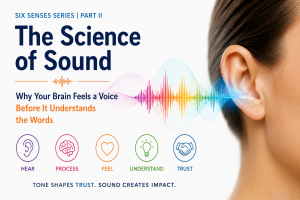
Six Senses Series | Part II — Hearing
You Hear More Than Words
Imagine answering two phone calls.
The first voice says,
“I’m really glad you called.”
The words are positive.
But the tone feels rushed, flat, and distracted.
The second voice says exactly the same sentence.
This time the voice sounds warm, relaxed, and genuinely happy.
The words never changed.
Your experience did.
Why?
Because the human brain processes far more than language.
It processes tone, pitch, rhythm, pace, pauses, and vocal emotion—often before it consciously interprets meaning.
That realization changes how we think about communication.
Buyers are not simply listening to what we say.
They are sensing how we say it.
Your Brain Has Specialized Regions Just for Human Voices
The human brain treats voices differently from every other sound.
Researchers have identified specialized “voice-selective” regions in the auditory cortex dedicated specifically to recognizing human voices and extracting socially important information.
These regions help us rapidly identify age, gender, identity, emotional state, and intention—often without consciously realizing it.
Source: NIH – The Developmental Origins of Voice Processing in the Human Brain
👉 https://pmc.ncbi.nlm.nih.gov/articles/PMC2852650/
More recent neuroscience research from the University of Pittsburgh found additional brain regions specifically recognize non-speech vocal sounds such as laughter, crying, sighs, coughing, and gasps because these sounds immediately communicate human emotion and intent.
Source: University of Pittsburgh
👉 https://www.upmcphysicianresources.com/news/072822-brain-regions
Before buyers fully understand our message… Their brain has already begun understanding us.
Your Voice Communicates Emotion Faster Than Your Words
Think about the last time someone said,
“I’m fine.”
Were they?
Sometimes yes.
Often no.
Because emotion frequently lives inside the voice rather than inside the words.
Researchers studying emotional prosody—the emotional qualities carried through speech—have found that listeners automatically decode changes in pitch, loudness, rhythm, speech rate, and pauses to understand emotion.
Even when the words remain identical, the emotional interpretation changes dramatically.
Source: NIH Review on Voice Processing
👉 https://pmc.ncbi.nlm.nih.gov/articles/PMC2852650/
Your voice constantly answers questions buyers may never ask aloud:
Can I trust you?
Do you believe what you’re saying?
Are you confident?
Are you present?
The answers often arrive before logic has a chance to respond.
Emotion Lives in the Sound, Not Just the Sentence
Scientists refer to this phenomenon as emotional prosody.
It explains why sarcasm works.
Why encouragement feels different from instruction.
Why one presentation energizes an audience while another puts them to sleep.
Research published in Brain Stimulation demonstrated that the right superior temporal gyrus plays a critical role in decoding emotional tone in speech, showing that the brain processes emotional vocal information through specialized neural pathways.
Source: Brain Stimulation
This reminds us of an important truth.
People hear our emotions long before they analyze our message.
Silence Is One of the Most Powerful Sounds
Many people think communication is about speaking.
Great communicators understand it is also about pausing.
Silence creates space.
Space creates reflection.
Reflection creates understanding.
When every sentence runs together without pause, the brain has less opportunity to organize information.
Strategic pauses allow ideas to settle while increasing anticipation for what comes next.
The best speakers, storytellers, teachers, and sales professionals understand this instinctively.
Sometimes the most influential moment in a conversation is the moment when nothing is said.
Music Quietly Changes Human Behavior
Hearing influences more than conversations.
It shapes environments.
One of the most influential studies in consumer psychology found that slower background music encouraged shoppers to move more slowly through stores and increased sales compared with faster music.
The music did not change the products.
It changed the experience.
Source: Ronald Milliman, Journal of Marketing
👉 https://psycnet.apa.org/record/1983-20937-001
The implication reaches far beyond retail.
Everything buyers hear contributes to how an experience feels.
The Sound of Leadership
Leadership is also heard before it is evaluated.
A calm voice communicates confidence.
A hurried voice communicates urgency.
A hesitant voice communicates uncertainty.
A steady voice communicates stability.
Leaders rarely inspire people through information alone.
They inspire through conviction.
And conviction has a sound.
Whether leading a sales meeting, coaching a team, delivering a keynote, or recording a podcast, your voice becomes part of your leadership brand.
The Selling Senses Connection
In Selling Senses, hearing extends far beyond listening.
Blog #12 explored why sellers must become better listeners.
This article explores the other side of the conversation:
What buyers hear when we speak.
The eye may capture attention.
The ear often builds trust.
Every conversation carries two messages.
The spoken message.
And the emotional message.
The most effective communicators align both.
Because when words and tone work together, buyers experience authenticity.
And authenticity builds confidence.
What the Research Really Shows
The evidence points toward an extraordinary conclusion:
- The human brain contains specialized regions dedicated to processing voices.
- Vocal emotion is decoded through dedicated neural systems before listeners consciously evaluate meaning.
- Sound influences behavior, emotion, and even purchasing activity.
- Tone, rhythm, pacing, and pauses all contribute to how messages are interpreted.
Together, these findings reveal something every leader, marketer, and sales professional should remember.
People do not simply hear information.
They hear confidence.
They hear uncertainty.
They hear authenticity.
They hear emotion.
Long before they decide whether to believe the message…
They have already begun interpreting the messenger.
Continue the Journey
This article is Part II of the Six Senses Series.
If you missed Part I, continue here:
Sight captures attention.
Sound gives that attention meaning.
You can also explore the complete Selling Senses blog library here:
👉 https://www.sellingsenses.com/blog/
Final Thought
Every conversation has two voices.
The one formed by words.
And the one formed by emotion.
Buyers hear both.
The question is…
Which one are they believing?
Closing Question
Think about someone whose voice immediately earns your trust. What is it about the way they speak—not what they say—that makes you believe them?
