The Lasting Taste of Experience: Why People Remember More Than What They Consume
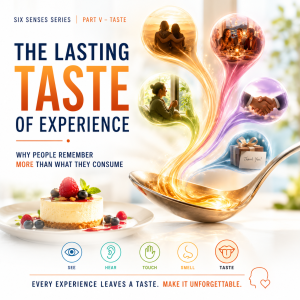
Six Senses Series | Part V — Taste
Some Experiences Leave a Taste That Lasts Long After They’re Over
Think about the phrase:
“That left a bad taste in my mouth.”
Most of the time… No one is talking about food.
They’re describing an experience.
A difficult conversation.
A disappointing customer interaction.
A broken promise.
Now consider the opposite.
A handwritten thank-you note.
An employee who solved your problem without being asked.
A leader who gave you credit instead of taking it.
Those moments leave a different kind of taste.
Long after the details fade, the feeling remains.
That is the remarkable power of taste.
It is more than a physical sensation.
It becomes a metaphor for how we remember experiences.
Taste Is Never Experienced Alone
Take a bite of a strawberry.
Is the sweetness determined only by your tongue?
Not even close.
Scientists have discovered that what we call flavor is actually a multisensory experience created by taste, smell, vision, texture, temperature, and even sound.
Your brain combines all of these sensory signals into what feels like a single experience.
Without smell, much of what we describe as flavor disappears.
Research from the National Institute on Deafness and Other Communication Disorders (NIDCD) explains that flavor depends on the integration of taste and smell, with additional contributions from texture, temperature, and chemesthetic sensations such as cooling or heat.
Research Source: Smell Disorders – National Institute on Deafness and Other Communication Disorders (NIDCD)
https://www.nidcd.nih.gov/health/smell-disorders
That insight reaches far beyond food.
Customers never evaluate one interaction in isolation.
They experience the whole.
Expectation Changes What We Taste
Imagine pouring the same wine into two different bottles.
One carries a prestigious label.
The other is plain.
Many people will genuinely believe one tastes better.
Why?
Because expectations shape perception.
Neuroscientists have shown that beliefs about a product can influence activity in brain regions associated with experienced pleasantness, meaning expectations don’t merely change opinions, they can change the experience itself.
Research Source: Plassmann, H., O’Doherty, J., Shiv, B., & Rangel, A. Marketing Actions Can Modulate Neural Representations of Experienced Pleasantness.
https://www.pnas.org/doi/10.1073/pnas.0706929105
People rarely experience reality without expectation.
Expectation becomes part of the experience.
The Brain Remembers the Ending
Psychologists Daniel Kahneman and Barbara Fredrickson demonstrated that people do not evaluate experiences by averaging every moment.
Instead, memory is disproportionately shaped by the emotional peak and the ending.
This is known as the Peak-End Rule.
A customer may overlook small frustrations if an experience ends exceptionally well.
Likewise, a great experience can be overshadowed by a poor conclusion.
Research Source: Kahneman, D., Fredrickson, B., Schreiber, C., & Redelmeier, D.
When More Pain Is Preferred to Less: Adding a Better End.
https://pubmed.ncbi.nlm.nih.gov/10492763/
Every interaction leaves a final impression.
Every final impression leaves a lasting taste.
The Best Brands Create Emotional Flavor
Think about your favorite restaurant.
You probably remember more than the meal.
You remember how you were greeted.
The atmosphere.
The conversation.
The presentation.
The laughter.
The people around the table.
The meal became inseparable from the experience.
The same is true in business.
People don’t buy products.
They consume experiences.
Every interaction adds another ingredient.
Eventually…
Your brand develops a flavor of its own.
The Selling Senses Connection
In Selling Senses, taste represents the emotional aftertaste of every interaction.
Did your customer leave feeling understood?
Did your presentation leave people inspired?
Did your leadership create confidence?
Did your service leave someone wanting to return?
Those questions matter because people rarely remember every detail.
They remember how the experience settled.
Long after the transaction ends…
Something remains.
That lingering impression becomes your reputation.
What the Research Really Shows
The evidence reveals an important truth.
- Flavor is created by multiple senses working together—not taste alone.
- Expectations shape how people experience products and services.
- The emotional peak and ending disproportionately influence how experiences are remembered.
- Great brands don’t simply satisfy customers.
They leave a lasting emotional aftertaste.
Together, these findings reveal something every leader, marketer, and salesperson should remember.
People don’t just consume products.
They consume experiences.
And every experience leaves a taste that shapes whether they return.
Research Sources
1. National Institute on Deafness and Other Communication Disorders (NIDCD)
Smell Disorders
https://www.nidcd.nih.gov/health/smell-disorders
2. Plassmann, H., O’Doherty, J., Shiv, B., & Rangel, A.
Marketing Actions Can Modulate Neural Representations of Experienced Pleasantness.
Proceedings of the National Academy of Sciences
https://www.pnas.org/doi/10.1073/pnas.0706929105
3. Kahneman, D., Fredrickson, B., Schreiber, C., & Redelmeier, D.
When More Pain Is Preferred to Less: Adding a Better End.
https://pubmed.ncbi.nlm.nih.gov/10492763/
Continue the Journey
This article is Part V of the Six Senses Series.
If you missed Part IV, continue here:
Smell creates lasting memories.
Taste leaves the final impression.
You can also explore the complete Selling Senses blog library here:
👉 https://www.sellingsenses.com/blog/
Final Thought
The most successful brands aren’t remembered because they offered the lowest price.
Or the fastest delivery.
Or the loudest advertising.
They’re remembered because every interaction left people feeling better than they expected.
Every conversation.
Every presentation.
Every customer experience.
Every act of leadership.
Leaves something behind.
The question isn’t whether your customers will remember you.
The question is…
What kind of taste will your experience leave behind?
Closing Question
Think about the best customer experience you’ve ever had. What made it unforgettable—and what emotional “taste” has stayed with you long after the experience ended?
